7 Brilliant Ways to Make a Dark Room Brighter
Disclosure: As an Amazon Associate, I earn from qualifying purchases. This post may contain affiliate links, which means I may earn a small commission at no extra cost to you. I only recommend products I genuinely think could help you create a cozier home.
How to use this guide: Recommendations describe product types and buying considerations, not hands-on tests of a specific model. Search links show matching options in Australia and the US. Check the seller’s dimensions, materials, instructions and current pricing before buying. See our editorial approach.
Some rooms seem determined to swallow every photon that enters them. You know the type—north-facing living rooms with one small window, basement apartments where “natural light” is more suggestion than reality, or bedrooms that somehow feel gloomy even at noon. The easiest fix is a fresh coat of white paint, but that’s not always possible when you’re renting, short on time, or simply dreading the fumes and drop cloths. The good news: you can make a dark room brighter using the mirror trick, strategic lighting, and a few styling shifts that require zero landlord permission.
Quick Takeaways: Brightening a Dark Room Without Paint
- Position a large mirror directly across from your biggest window to bounce light deep into the room
- Swap heavy drapes for sheer voile curtains that diffuse light without blocking it
- Layer three light sources—ambient, task, and accent—at different heights
- Replace cool-toned bulbs with warm white LEDs (2700K–3000K) for a brighter, cozier glow
- Add peel-and-stick mirror tiles to dim corners or narrow hallways for instant reflection
Why Dark Rooms Feel Oppressive (and What Actually Fixes It)
A dark room isn’t just about lumens—it’s about how light behaves once it enters. Hard surfaces bounce light; soft, dark fabrics absorb it. When natural light hits a charcoal sofa, a dark rug, and navy walls, most of it vanishes. The solution isn’t necessarily flooding the space with more wattage. It’s redirecting and multiplying the light you already have.
According to the U.S. Department of Energy, layered lighting combined with reflective surfaces can reduce the need for overhead fixtures by up to 40%. That means a brighter-feeling room without the glare of a dentist’s office. Below, I’ll walk through the most effective dark room ideas that don’t require a single brushstroke—starting with the classic mirror trick that actually works.
The Mirror Trick: How to Bounce Light Like a Pro
Mirrors are the oldest trick in the interior-design playbook, but most people hang them wrong. A mirror on a random wall does nothing for brightness. The magic happens when you position it directly across from or perpendicular to your largest light source—usually a window. This creates a “second window” effect, bouncing daylight into the room’s darker corners.
For maximum impact, choose a mirror that’s at least half the width of your window. Floor-length styles work especially well in dark living rooms because they reflect light at eye level, where you actually notice it. Leaning a large mirror against the wall at a slight angle also catches more light than hanging it flat.
#1 Best Statement Mirror for Dark Living Rooms: Large Wall Mirror
Best for: Maximising natural light bounce | Why we picked it: Full-height reflection doubles perceived light
A large wall mirror is the single most effective tool for transforming a dim room. Position it across from your window, and suddenly that meagre afternoon light feels twice as generous. This approach works in any room—living areas, bedrooms, even narrow hallways that never see direct sun. The bigger the mirror, the more dramatic the effect.
- ✓ Creates a “second window” effect without structural changes
- ✓ Adds depth, making small rooms feel larger
- ✓ Works instantly—no drying time, no fumes
- ✗ Requires secure wall mounting for safety
Bottom line: If you buy one thing from this list, make it a large mirror. Check the retailer for current pricing; depending on frame style, it’s the fastest path from cave to bright, airy space.
Browse matching options on Amazon AU · Browse matching options on Amazon US
#2 Best Ambient Lighting for Cozy Brightness: Arc Floor Lamp with Dimmer
Best for: Creating a warm ambient reading corner | Why we picked it: Adjustable glow suits any time of day
Overhead fixtures can feel harsh in a dark space—they create shadows instead of eliminating them. An arc floor lamp solves this by casting light downward and outward from a gentle angle. The dimmer switch lets you dial in exactly the right brightness, from full power during grey afternoons to a soft glow for evening reading. It’s ambient lighting that actually feels inviting.
- ✓ Illuminates seating areas without glare
- ✓ Foot dimmer allows hands-free adjustment
- ✓ Sculptural design adds visual interest
- ✗ Requires floor space beside sofa or chair
Bottom line: If your room feels dim even with the ceiling light on, an arc lamp fills the mid-level lighting gap. Expect to pay (check current retailer pricing) for a quality version with a dimmer—worth it for the daily mood lift.
Browse matching options on Amazon AU · Browse matching options on Amazon US
Let the Light In: Why Heavy Drapes Are Sabotaging Your Room
Thick curtains block more light than most people realise—even when pulled aside. The fabric bunches at the window edges, narrowing the actual glass area where sunlight can enter. Switching to sheer panels lets you maintain privacy (especially important in ground-floor flats) while allowing nearly all daylight to filter through. The effect is softer, more diffused light that reaches deeper into the room.
If blackout curtains are non-negotiable for your bedroom, consider a double rod: sheers closest to the glass for daytime, blackouts on the outer layer for sleeping. You get the best of both without compromising your dark space during waking hours.
#3 Best Window Treatment for Maximising Daylight: Sheer Voile Curtains
Best for: Softening light while preserving privacy | Price: (check current retailer pricing) per panel | Why we picked it: Diffuses harsh sun without blocking it
Sheer voile curtains are the unsung heroes of bright interiors. They filter direct sunlight into a gentle, even glow that feels like permanent golden hour. Unlike heavier fabrics, they don’t create a stark line between window and room—the light wraps around the space instead. Perfect for living rooms, home offices, or any room where you need both illumination and a bit of screening from neighbours.
- ✓ Allows up to 80% of natural light through
- ✓ Creates soft, diffused glow—no harsh shadows
- ✓ Lightweight fabric works on tension rods (renter-friendly)
- ✗ Offers minimal privacy after dark without a secondary layer
Bottom line: check the retailer for current pricing; per panel, sheer voile curtains are one of the cheapest ways to instantly brighten a room. Pair with blinds or blackouts if you need nighttime privacy.
Browse matching options on Amazon AU · Browse matching options on Amazon US
Sneaky Reflections: Using Small Mirrors in Unexpected Places
Not every wall can handle a floor-length mirror, and that’s okay. Peel-and-stick mirror tiles offer the same light-bouncing benefit on a smaller scale—perfect for awkward corners, narrow hallways, or above console tables. Arrange them in a grid, a diagonal pattern, or scattered randomly for a more artful look. They’re especially useful in rental flats where drilling isn’t allowed.
The key is placement. Stick them where they’ll catch light from a window or lamp, not in a dead corner where there’s nothing to reflect. A cluster near your entry can make a dim foyer feel surprisingly welcoming.
#4 Best Renter-Friendly Solution for Dim Corners: Mirror Tiles Peel Stick
Best for: Adding reflection without wall damage | Why we picked it: Removable adhesive leaves walls intact
Peel-and-stick mirror tiles are the commitment-phobes’ answer to the mirror trick. Arrange them as a statement piece behind a shelf, in a dark hallway, or clustered in a corner that never sees direct light. They bounce ambient light from lamps just as effectively as natural light from windows. And when you move out? They peel off cleanly.
- ✓ No drilling, no landlord negotiations
- ✓ Flexible arrangements—grid, diagonal, scattered
- ✓ Lightweight enough for most wall surfaces
- ✗ Adhesive may loosen in humid bathrooms
Bottom line: A set of peel-and-stick mirror tiles ( (check current retailer pricing)) is perfect for renters who want the light-bouncing effect without permanent changes. Ideal for hallways, entries, and awkward alcoves.
Browse matching options on Amazon AU · Browse matching options on Amazon US
The Bulb Swap That Changes Everything
The colour temperature of your light bulbs matters more than their wattage. Cool white bulbs (4000K+) make dark rooms feel sterile and somehow still dim—like a budget hotel bathroom. Warm white LEDs in the 2700K–3000K range produce a golden glow that reads as brighter and more inviting, even at the same lumen output. It’s a simple swap that takes five minutes and costs under £10.
For dark space rescue missions, aim for at least 800 lumens per bulb in overhead fixtures and 400–600 lumens in table lamps. The combination of adequate brightness and warm tone creates a room that feels illuminated without being clinical. If you’re curious about building a layered lighting scheme, our guide to cozy living room lighting walks through the full approach.
#5 Best Quick Fix for Dingy Overhead Lights: Warm White LED Bulb
Best for: Instant warmth in any existing fixture | Price: (check current retailer pricing) for a multi-pack | Why we picked it: Transforms light quality in under a minute
Swapping to a warm white LED bulb is the lowest-effort upgrade with the highest impact. That overhead fixture you’ve been blaming for your room’s dungeon vibe? Probably just has the wrong bulb in it. A 2700K LED produces the same golden glow as an old incandescent, but lasts years longer and uses a fraction of the energy. You’ll notice the difference the second you flip the switch.
- ✓ Fits standard E26/E27 sockets—no rewiring needed
- ✓ 2700K–3000K range mimics natural candlelight
- ✓ Energy-efficient with 15,000+ hour lifespan
- ✗ Non-dimmable versions won’t work with dimmer switches
Bottom line: check the retailer for current pricing; for a multi-pack, warm white LED bulbs are the cheapest way to make a dark room brighter. Replace every bulb in the space for a cohesive, cozy glow.
Browse matching options on Amazon AU · Browse matching options on Amazon US
Styling Tips: Small Changes That Add Up
Beyond mirrors and bulbs, a few styling shifts can amplify your room’s brightness. Swap dark throw pillow covers for cream, ivory, or soft metallics—they reflect light instead of absorbing it. Choose furniture with exposed legs; the visible floor space underneath makes rooms feel airier. Position your largest lamp in the darkest corner rather than next to the window, where natural light already does the work.
Glossy or metallic finishes on accessories—picture frames, vases, trays—also bounce light around the room. You don’t need a full makeover, just a few strategic swaps. If you’re working with a small space that’s both dark and cramped, our small apartment storage ideas offer ways to reduce visual clutter, which makes any room feel brighter.
Which Brightening Method Should You Try First?
Start with the mirror trick—a large mirror opposite your window delivers the most dramatic change for the least effort. Next, swap your bulbs to warm white LEDs; it takes minutes and costs almost nothing. If your window treatments are heavy, switching to sheer voile curtains makes an immediate difference to daytime brightness. The arc lamp and mirror tiles are finishing touches that round out a full lighting strategy.
For rooms that still feel gloomy after these changes, consider adding reflective surfaces like a glass coffee table or metallic accents. Sometimes a dark room just needs more surfaces to bounce light around. The goal isn’t to flood the space with harsh wattage—it’s to make the light you have work harder.
| Product | Best For | Key Feature | Ideal Room | Check Price |
|---|---|---|---|---|
| Large Wall Mirror | Maximum light bounce | Full-height reflection | Living room, bedroom | Browse matching options on Amazon AU · Browse matching options on Amazon US |
| Arc Floor Lamp with Dimmer | Warm ambient corners | Adjustable dimmer switch | Living room, reading nook | Browse matching options on Amazon AU · Browse matching options on Amazon US |
| Sheer Voile Curtains | Maximising daylight | 80% light transmission | Any room with windows | Browse matching options on Amazon AU · Browse matching options on Amazon US |
| Mirror Tiles Peel Stick | Renter-friendly reflection | Removable adhesive | Hallways, entries, corners | Browse matching options on Amazon AU · Browse matching options on Amazon US |
| Warm White LED Bulb | Instant fixture upgrade | 2700K golden glow | Every room | Browse matching options on Amazon AU · Browse matching options on Amazon US |
Frequently Asked Questions
What is the best way to make a dark room brighter without painting?
The most effective method is positioning a large mirror directly across from your biggest window. This bounces natural light deep into the room, effectively doubling your light source. Combining the mirror trick with warm white LED bulbs and sheer curtains creates the most noticeable improvement.
How does the mirror trick work to brighten a room?
A mirror reflects light in the same way a second window would. When placed opposite or perpendicular to a window, it catches incoming daylight and redirects it into darker areas of the room. The larger the mirror and the closer it is to the light source, the more dramatic the effect.
What colour temperature bulb is best for dark rooms?
Warm white LED bulbs in the 2700K–3000K range create the most inviting brightness. These mimic the golden tone of incandescent bulbs while being energy-efficient. Avoid cool white bulbs (4000K+), which can make dim rooms feel sterile rather than cozy.
Do sheer curtains really make a difference in dark spaces?
Yes—sheer voile curtains allow up to 80% of natural light to pass through while still providing daytime privacy. Heavy drapes can block significant light even when pulled aside. Switching to sheers is one of the simplest and cheapest ways to brighten a room with limited windows.
Are peel-and-stick mirror tiles renter-friendly?
Most peel-and-stick mirror tiles are designed with removable adhesive that doesn’t damage walls. They’re ideal for renters who can’t drill holes for a traditional mirror. Check that the adhesive is rated for easy removal and test a small area first on delicate surfaces.
Where should I place lamps to brighten a dark room?
Position your brightest lamp in the darkest corner of the room, not next to the window where natural light already reaches. An arc floor lamp beside a sofa works well because it casts light downward and outward. Layering multiple light sources at different heights creates the most even illumination.
When is the best time to buy lighting and mirrors on sale?
Can I brighten a basement room without windows?
Absolutely. Focus on layered artificial lighting—overhead, mid-level, and table lamps—all with warm white LEDs. Add mirrors or reflective surfaces to bounce that light around. Glossy finishes on furniture and metallic accents also help multiply the available light throughout the space.
How many lumens do I need to brighten a dark living room?
Aim for a total of 1,500–3,000 lumens for an average living room, spread across multiple light sources. This might mean 800-lumen overhead fixtures plus 400–600-lumen table or floor lamps. The key is distributing light evenly rather than relying on one bright source that creates harsh shadows.
A dark room doesn’t have to stay that way—and you don’t need your landlord’s permission to fix it. Start with a large mirror opposite your window, swap those cold bulbs for warm white LEDs, and let the light in with sheer curtains. These simple changes cost less than a weekend brunch and take about the same amount of time. Your formerly gloomy space will thank you every time the afternoon sun finally has somewhere to go.
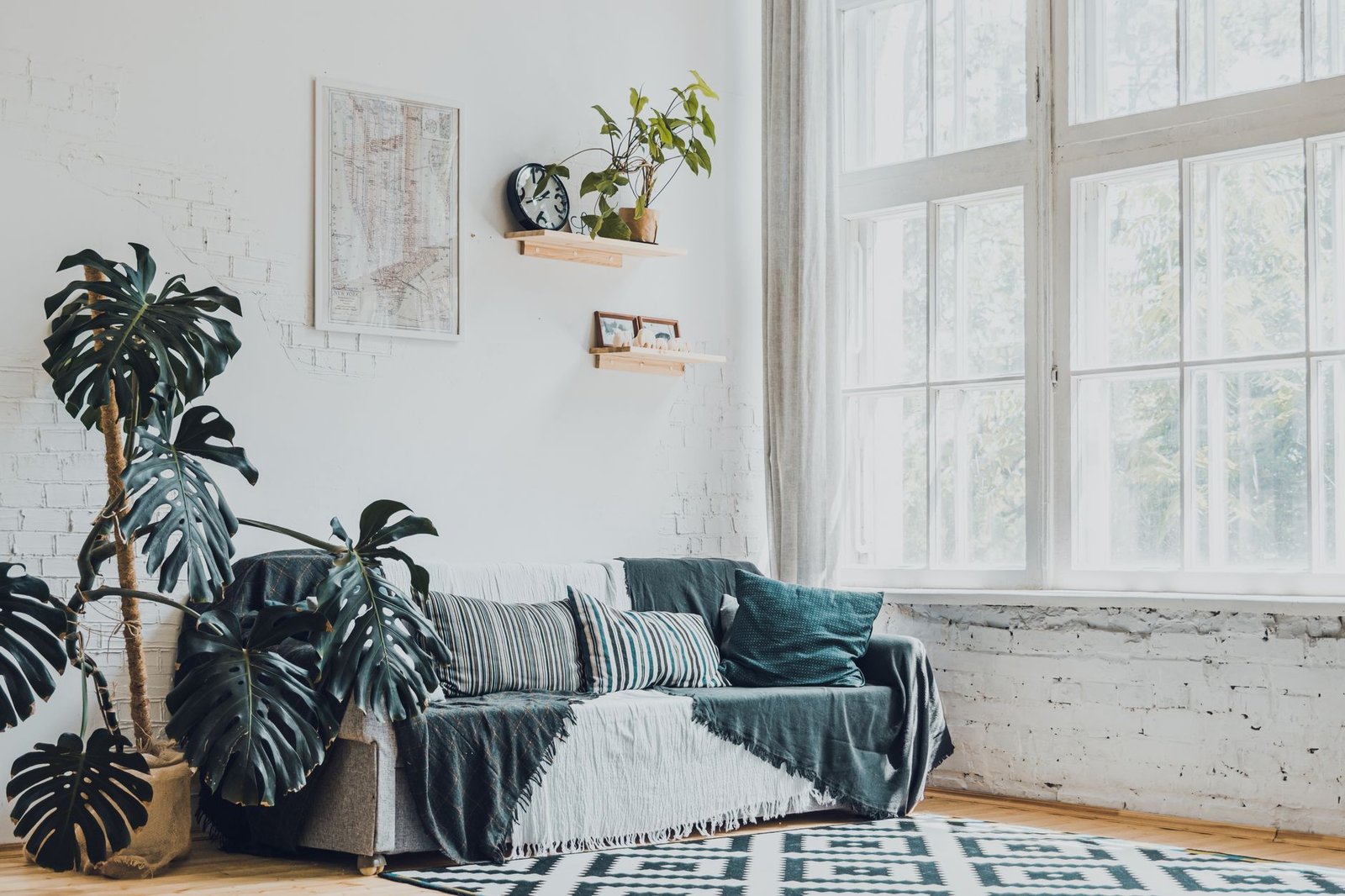
Featured image: Photo by Stanislav Kondratiev on Pexels